1954
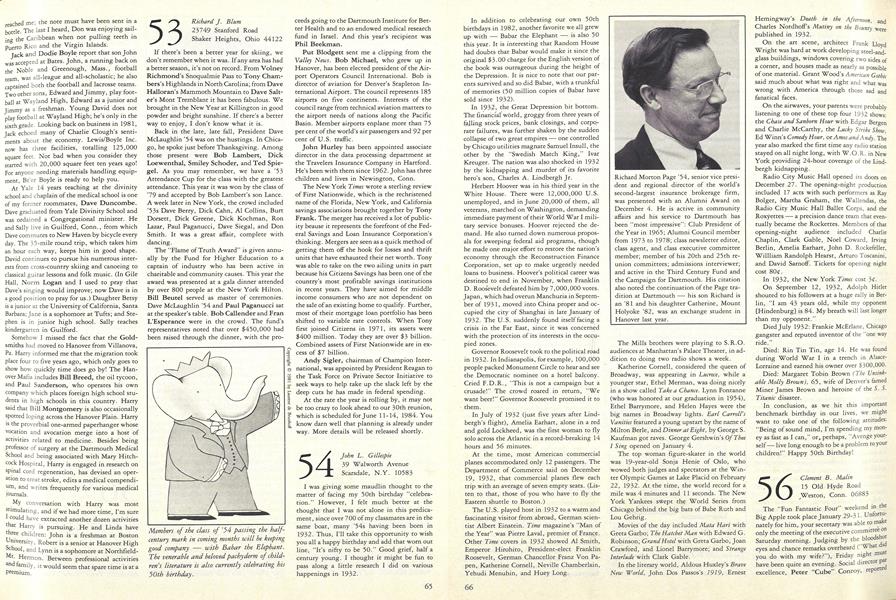
I was giving some maudlin thought to the matter of facing my 50th birthday "celebration." However, I felt much better at the thought that I was not alone in this predicament, since over 700 of my classmates are in the same boat, many '54s having been born in 1932. Thus, I'll take this opportunity to wish you all a happy birthday and add that worn out line, "It's nifty to be 50." Good grief, half a century young. I thought it might be fun to pass along a little research I did on various happenings in 1932.
In addition to celebrating our own 50th birthdays in 1982, another favorite we all grew up with - Babar the Elephant - is also 50 this year. It is interesting that Random House had doubts that Babar would make it since the original $3.00 charge for the English version of the book was outrageous during the height of the Depression. It is nice to note that our parents survived and so did Babar, with a trunkful of memories (50 million copies of Babar have sold since 1932).
In 1932, the Great Depression hit bottom. The financial'world, groggy from three years of falling stock prices, bank closings, and corporate failures, was further shaken by the sudden collapse of two great empires - one controlled by Chicago utilities magnate Samuel Insull, the other by the "Swedish Match King," Ivar Kreuger. The nation was also shocked in 1932 by the kidnapping and murder of its favorite hero's son, Charles A. Lindbergh Jr.
Herbert Hoover was in his third year in the White House. There were 12,000,000 U.S. unemployed, and in June 20,000 of them, all veterans, marched on Washington, demanding immediate payment of their World War I military service bonuses. Hoover rejected the demand. He also turned down numerous proposals for sweeping federal aid programs, though he made one major effort to restore the nation's economy through the Reconstruction Finance Corporation, set up to make urgently needed loans to business. Hoover's political career was destined to end in November, when Franklin D. Roosevelt defeated him by 7,000,000 votes. Japan, which had overun Manchuria in September of 1931, moved into China proper and occupied the city of Shanghai in late January of 1932. The U.S. suddenly found itself facing a crisis in the Far East, since it was concerned with the protection of its interests in the occupied zones.
Governor Roosevelt took to the political road in 1932. In Indianapolis, for example, 100,000 people packed Monument Circle to hear and see the Democratic nominee on a hotel balcony. Cried F.D.R., "This is not a campaign but a crusade!" The crowd roared in return, "We want beer!" Governor Roosevelt promised it to them.
In July of 1932 (just five years after Lindbergh's flight), Amelia Earhart, alone in a red and gold Lockheed, was the first woman to fly solo across the Atlantic in a record-breaking 14 hours and 56 minutes.
At the time, most American commercial planes accommodated only 12 passengers. The Department of Commerce said on December 19, 1932, that commercial planes flew each trip with an average of seven empty seats. (Listen to that, those of you who have to fly the Eastern shuttle to Boston.)
The U.S. played host in 1932 to a warm and fascinating visitor from abroad, German scientist Albert Einstein. Time magazine's "Man of the Year" was Pierre Laval, premier of France. Other Time covers in 1932 showed Al Smith, Emperor Hirohito, President-elect Franklin Roosevelt, German Chancellor Franz Von Papen, Katherine Cornell, Neville Chamberlain, Yehudi Menuhin, and Huey Long.
The Mills brothers were playing to S.R.O. audiences at Manhattan's Palace Theater, in addition to doing two radio shows a week.
Katherine Cornell, considered the queen of Broadway, was appearing in Lucrece, while a younger star, Ethel Merman, was doing nicely in a show called Take a Chance. Lynn Fontanne (who was honored at our graduation in 1954), Ethel Barry more, and Helen Hayes were the big names in Broadway lights. Earl Carroll'sVanities featured a young upstart by the name of Milton Berle, and Dinner at Eight, by George S. Kaufman got raves. George Gershwin's Of TheeI Sing opened on January 4.
The top woman figure-skater in the world was 19-year-old Sonja Henie of Oslo, who wowed both judges and spectators at the Winter Olympic Games at Lake Placid on February 22, 1932. At the time, the world record for a mile was 4 minutes and 11 seconds. The New York Yankees swept the World Series from Chicago behind the big bats of Babe Ruth and Lou Gehrig.
Movies of the day included Mata Hart with Greta Garbo; The Hatchet Man with Edward G. Robinson; Grand Hotel with Greta Garbo, Joan Crawford, and Lionel Barrymore; and StrangeInterlude with Clark Gable.
In the literary world, Aldous Huxley's BraveNew World, John Dos Passos's 1919, Ernest Hemingway's Death in the Afternoon, and Charles Nordhoff's Mutiny on the Bounty were published in 1932.
On the art scene, architect Frank Lloyd Wright was hard at work developing steel-and-glass buildings, windows covering two sides of a corner, and houses made as nearly as possible of one material. Grant Wood's American Gothic said much about what was right and what was wrong with America through those sad and fanatical faces.
On the airwaves, your parents were probably listening to one of these top four 1932 shows: the Chase and Sanborn Hour with Edgar Bergen and Charlie McCarthy, the Lucky Strike Show, Ed Winn's Comedy Hour, or Amos and Andy. The year also marked the first time any radio station stayed on all night long, with W.O.R. in New York providing 24-hour coverage of the Lindbergh kidnapping.
Radio City Music Hall opened its doors on December 27. The opening-night production included 17 acts with such performers as Ray Bolger, Martha Graham, the Wallendas, the Radio City Music Hall Ballet Corps, and the Roxyettes - a precision dance team that eventually became the Rockettes. Members of that opening-night audience included Charlie Chaplin, Clark Gable, Noel Coward, Irving Berlin, Amelia Earhart, John D. Rockefeller, Willliam Randolph Hearst, Arturo Toscanin, and David Sarnoff. Tickets for opening night cost 80c.
In 1932, the New York Times cost 3c On September 12, 1932, Adolph Hitler shouted to his followers at a huge rally in Berlin, "I am 43 years old, while my opponent {Hindenburg} is 84. My breath will last longer than my opponent."
Died July 1932: Frankie McErlane, Chicago gangster and reputed inventor of the"one way ride."
Died: Rin Tin Tin, age 14. He was found during World War I in a trench in Alsace-Lorraine and earned his owner over $300,000.
Died: Margaret Tobin Brown (The Unsinkable Molly Brown), 65, wife of Denver's famed Miner James Brown and heroine of the S. S.Titanic disaster.
In conclusion, as we hit this important benchmark birthday in our lives, we might want to take one of the following attitudes. "Being of sound mind, I'm spending my money as fast as I can," or, perhaps, "Avenge yourself - live long enough to be a problem to your children!" Happy 50th Birthday!
Richard Morton Page '54, senior vice president and regional director of the world's second-largest insurance brokerage firm, was presented with an Alumni Award on December 4. He is active in community affairs and his service to Dartmouth has been "most impressive": Club President of the Year in 1965; Alumni Council member from 1973 to 1978; class newsletter editor, class agent, and class executive committee member; member of his 20th and 25th reunion committees; admissions interviewer; and active in the Third Century Fund and the Campaign for Dartmouth. His citation also noted the continuation of the Page tradition at Dartmouth his son Richard is an '81 and his daughter Catherine, Mount Holyoke '82, was an exchange student in Hanover last year.
39 Walworth Avenue Scarsdale, N.Y. 10583
More From This Issue
-
 Feature
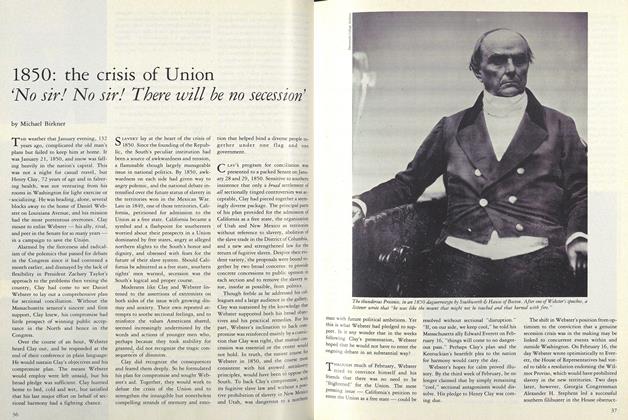
1850: the crisis of Union 'No sir! No sir! There will be no secession'
March 1982 -
 Feature
The naivete of nuclear rivalry
March 1982 -
 Feature
'One day it came to me: sherry for breakfast was a good idea.'
March 1982 -
 Cover Story
Picking books Classic title, quirky tastes
March 1982 -
 Article
Someone wrote them, but did anyone read them?
March 1982 -
 Class Notes
1959
March 1982