1897
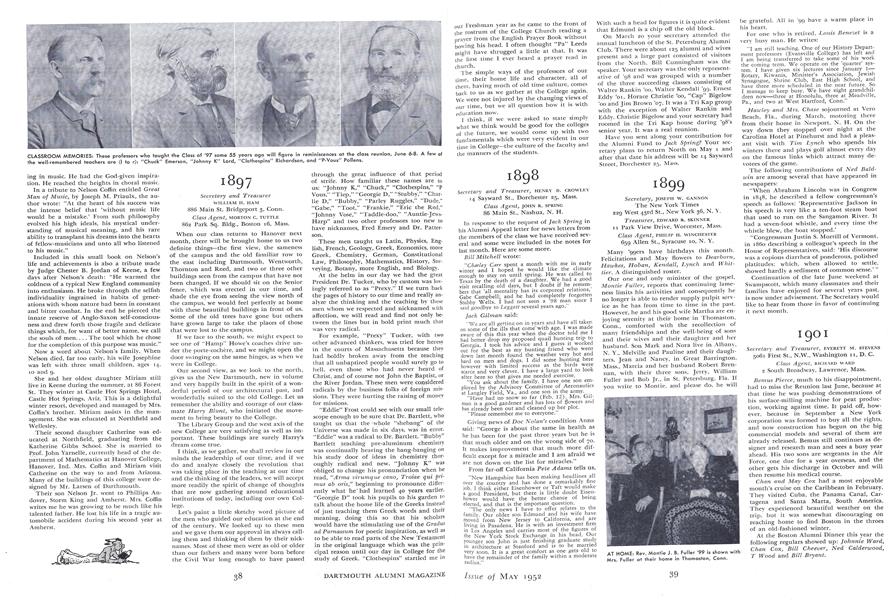
When our class returns to Hanover next month, there will be brought home to us two definite things—the first view, the sameness of the campus and the old familiar row to the east including Dartmouth, Wentworth, Thornton and Reed, and two or three other buildings seen from the campus that have not been changed. If we should sit on the Senior fence, which was erected in our time, and shade the eye from seeing the view north of the campus, we would feel perfectly at home with these beautiful buildings in front of us. Some of the old trees have gone but others have grown large to take the places of those that were lost to the campus.
If we fate to the south, we might expect to see one of "Hamp" Howe's coaches drive under the porte-cochere, and we might open the door swinging on the same hinges, as when we were in College.
Our second view, as we look to the north, gives us the New Dartmouth, new in volume and very happily built in the spirit of a wonderful period of our architectural past, and wonderfully suited to the old College. Let us remember the ability and courage of our classmate Harry Blunt, who initiated the movement to bring beauty to the College.
The Library Group and the west axis of the new College are very satisfying as well as important. These buildings are surely Harry's dream come true.
I think, as we gather, we shall review in our minds the leadership of our time, and if we do and analyze closely the revolution that was taking place in the teaching at our time and the thinking of the leaders, we will accept more readily the spirit of change of thoughts that are now gathering around educational institutions of today, including our own College.
Let's paint a little sketchy word picture of the men who guided our education at the end of the century. We looked up to these men and we gave them our approval in always calling them and thinking of them by their nicknames. Most of these men were as old or older than our fathers and many were born before the Civil War long enough to have passed through the great influence of that period of strife. How familiar these names are to us: "Johnny K," "Chuck," "Clothespins," "P Vous," "Tiep," "Georgie D," "Stubby," "Charlie D," "Bubby," "Parley Ruggles," "Dude," "Gabe," "Toot," "Frankie," "Eric the Red," "Johnny Vose," "Taddle-doo," "Auntie-Jews-Harp" and two other professors too new to have nicknames, Fred Emery and Dr. Patterson.
These men taught us Latin, Physics, English, French, Geology, Greek, Economics, more Greek, Chemistry, German, Constitutional Law, Philosophy, Mathematics, History, Sur- veying, Botany, more English, and Biology.
At the helm in our day we had the great President Dr. Tucker, who by custom was lovingly referred to as "Prexy." If we turn back the pages of history to our time and really analyze the thinking and the teaching by these men whom we respected and nicknamed with affection, we will read and find not only between the lines but in bold print much that was very radical.
For example, "Prexy" Tucker, with two other advanced thinkers, was tried for heresy in the courts of Massachusetts because they had boldly broken away from the teaching that all unbaptized people would surely go to hell, even those who had never heard of Christ, and of course not John the Baptist, or the River Jordan. These men were considered radicals by the business folks of foreign missions. They were hurting the raising of money for missions.
"Eddie" Frost could see with our small telescope enough to be sure that Dr. Bartlett, who taught us that the whole "shebang" of the Universe was made in six days, was in error. "Eddie" was a radical to Dr. Bartlett. "Bubby" Bartlett teaching pre-aluminum chemistry was continually hearing the bang-banging on his study door of ideas in chemistry thoroughly radical and new. "Johnny K" was obliged to change his pronunciation when he read, "Arma virumque cano, Troiae qui primus ab oris," beginning to pronounce differently what he'had learned 40 years earlier. "Georgie D" took his pupils to his garden to talk about the home life of the Greeks instead of just teaching them Greek words and their meaning, doing this so that his scholars would have the stimulating use of the Gradusad Parnassum for poetic inspiration, as well as to be able to read parts of the New Testament in the original language which was the principal reason until our day in College for the study of Greek. "Clothespins" startled me in our Freshman year as he came to the front of the rostrum of the College Church reading a prayer from the English Prayer Book without bowing his head. I often thought "Pa" Leeds might have shrugged a little at that. It was the first time I ever heard a prayer read in church.
The simple ways of the professors of our time, their home life and character, all of them, having much of old time culture, comes back to us as we gather at the College again. We were not injured by the changing views of our time, but we all question how it is with education now.
I think, if we were asked to state simply what we think would be good for the colleges of the future, we would come up with two fundamentals which were very evident in our time in College—the culture of the faculty and the manners of the students.
Secretary and Treasurer 886 Main St. Bridgeport 3, Conn. Class Agent, 862 Park Sq. Bldg., Boston 16, Mass.