1896
As another in the series of life sketches of members of the Class of 1896, the following report comes from:
ISAAC JOSLIN COX
I am glad of the opportunity to review for my classmates my activities of 50 years in the teaching profession. Naturally, one would begin with the years of preparation. In my case three sections of our country contributed to this period. New Jersey furnished the district schools. New Hampshire followed with two years at Kimball Union Academy and four fruitful years at Dartmouth. Texas then took over to offset this Yankee training with six years of teaching at San Antonio Academy. The University of Pennsylvania then called me East on a Harrison Fellowship for two years of graduate study, capped by the Ph.D. degree.
The years of college teaching began in 1904. The first 15 were centered at the University of Cincinnati but nine of the summers were spent as visiting professor at other universities from Columbia to California and from Pennsylvania and Tennessee to Colorado. This variety in the place of teaching also gave further opportunities for research and travel to eastern centers, the South, and the Far West; to Mexico, Spain, Paris and London. Incidentally the family also shared some of these experiences. Thus the nationalistic tendency developed during the years of preparation was further emphasized in this first decade and a half of college performance.
As a mistress, history demands double service of her devotees. This became apparent even while teaching in San Antonio. The locality and the people turned my attention toward the southern border and its early frontier problems. A bicycle trip with a fellow companion in the summer of 1898 opened up the mountains and tablelands of Mexico and, more to the point, its historical archives. The Texas State Historical Association welcomed me as a member, shared with me the joys of common research and led me into an ever-expanding circle of scholars in this country and abroad. The list of articles thus inspired has grown with the years. The University of Cincinnati added another field, the Old Northwest, without breaking this early connection.
In 1918 a second leave of absence permitted me to join for several months a group that was engaged in a special study of Mexico. Its members worked under the auspices of the University of California. In the following year Northwestern University invited me to join its faculty, with Latin America as my special field for teaching and research. A shift in working centers was fairly general at the time. It marked a definite expansion in University instruction, especially in the graduate field and brought me into a growing circle of friends among both students and colleagues. Regional and national historical organizations contributed to the same end. Residence in the Mid West carried with it membership, and in two cases the presidency, of regional historical groups and a wider connection with the American Historical Association, including a term on its Executive Council.
Twenty-two years of active service at Northwestern were varied by summer and other teaching engagements at Columbia, Chicago, Stanford and Southern California; by subventions for travel and study in the Caribbean, South and Central America and Europe; and by numerous general and special speaking engagements. These years, like the preceding periods at San Antonio and at Cincinnati, gave rise to a gratifying list of library cards. Most of these bear titles describing some phase of frontier activity—during the colonial or early national era. Some were biographical in character; in later years all turned more definitely toward Latin America. The municipal history of early San Antonio, the Louisiana-Texas frontier, the diplomacy of the Old Northwest furnished most of the titles. Later Mexico and its recent history, the development of Chile, and Latin-American diplomacy furnished the background.
A summer's work in 1903 in the New York office of the New International Encyclopedia started me on a line of articles that was continued in the Britannica, the Americana and the Dictionary ofAmerican Biography. Perhaps the outstanding contribution of this type is the sketch of Aaron Burr in the last-named work. A number of scattered articles dealing with him and James Wilkinson have appeared in various historical reviews and have been extensively quoted. Chile, Colombia and Mexico have absorbed most of my effort in this field.
Of what may be termed full-fledged monographs one may mention The Early Exploration of Louisiana (University of Cincinnati Press, 1905); TheWest Florida Controversy (Johns Hopkins University Press, 1918); and Nicaragua and the UnitedStates ("World Peace Foundation, 1928). A personal tribute, William Blecher-Seeley, Founder andFirst Principal of the San Antonio Academy, appeared from the Naylor Press of that City in 1945. My first formal book was The Journey of LaSalleand his Companions (A. S. Barnes & Co., N. Y., 1905). In 1941 appeared my translation of The History of Chile by Louis Galdames (University of North Carolina Press, 1935).
This was preceded in 1935 by my cooperation in a series of lectures on Argentina, Brazil and Chilesince Independence: in which Chile (pp. 279-414) fell to my lot. (George Washington University Press, 1935.) A sketch "The Development of the .educational System of Mexico" appeared in theMexican Year Book (1921): El Desarollo de laDemocracia Norte-Americana was published by the University of Chile Press, in 1942.
The titles and places of publication of these studies point to recognition of scholarship rather than monetary returns for the author. The ominous word "retirement" seems hardly to apply to the years since 1941. The first of these Mrs. Cox and I spent on our second trip together to South America. It was my sixth to some part of that continent. This was preceded by five weeks in Hanover—my first autumn visit to New Hampshire since graduation. The contacts then established with faculty and students at Dartmouth and Kimball Union were enhanced by meeting with classmates during and after the annual Dartmouth-Harvard encounter, rather than by the outcome of that game. F. H. Noyes '97 introduced me to a delightful and it seemed a charitable Boston audience. This visit to New England formed a colorful prelude to the extended Southern visit to Chile.
Pearl Harbor occurred during the brief stay in Peru on our way down. We experienced the usual hospitality of the latter country while giving a summer course (in January) at the University of Chile and preparing the lectures for publication. Our return late in the summer of '42 was on a Chilean ship through the Pacific and thence from Panama to New Orleans via Havana. At each place en route, as in New England, and in the complimentary dinner at Evanston before our departure we received the personal tributes that warm the heart of the old professor and his wife. Life, it seemed, was just beginning instead of reaching the conventional ending.
So in a sense it proved. An invitation from a former student took us to Louisiana State University for the remaining years of World War II. Three winters in San Antonio helped to renew friendships of early teaching days amid the scenes of courtship. I lectured a semester in each of the last two years at Trinity University in San Antonio and revamped some of my earlier interpretations of Texas history. Nor did the peripatetic pedagogue then cease his wanderings, for he and his wife held their last family reunion in California during the fall of 1949 and incidentally delivered sundry lectures en route and then took the back track to the University of New Mexico. There I gave a full schedule of lectures during the second semester. Toward the close, one of my students remarked— within earshot but not for my hearing: "The Old Doc still has a good stride." With that pronouncement after a half century of routine effort, we may reasonably conclude that it is a good time for me to get out from behind the teacher's desk.
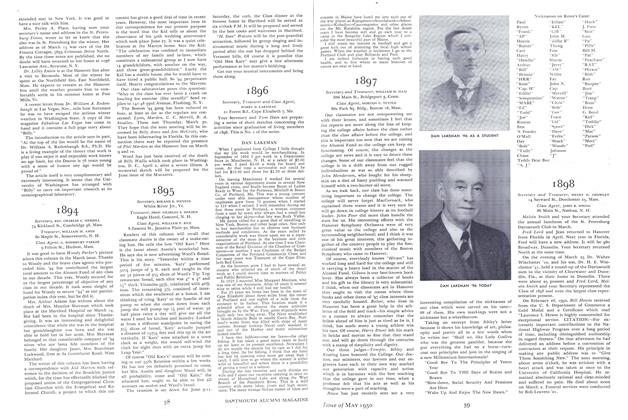
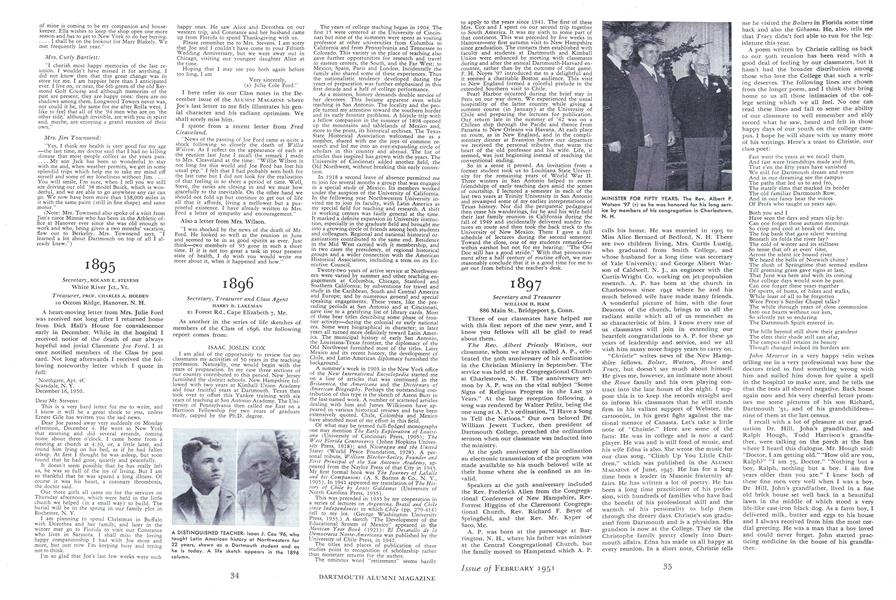
A DISTINGUISHED TEACHER: Isaac J. Cox '96, who taught Latin American history at Northwestern for 22 years, shown as a Dartmouth student and as he is today. A life sketch appears in the 1896 column.
Secretary, Treasurer and Class Agent 21 Forest Rd., Cape Elizabeth 7, Me.