1929
This is being written some few days beyond the deadline, and if the June issue carries it and my record is thus preserved, all thanks to Sid Hayward for his indulgence and dispensation. Perhaps when the draft catches up to me later in the year, the secretarial dispatches will be on schedule and more interesting.
Nat Barrows has left his Albuquerque home for Bachelor's Quarters, Fort Reno, Oklahoma, from which address he writes: "I signed up as a Volunteer Officer Candidate in the Army.of the United States last July and was inducted as a buck private August 13, 1942, at Santa Fe, New Mexico. Was subjected to Basic Training in the Quartermaster Corps at Fort Francis E. Warren, Cheyenne, Wyoming from August 17 to November 21. Entered Officer Candidate School on the latter date, emerging as a second lieutenant in the Quartermaster Corps on Feb. 19. The highlight of my career at O.C.S. was the fact that General Warden chose my Dad to be the 'Representative Father' of our class. Dad reviewed the troops and gave a grand speech at the graduation exercises, which was sincerely appreciated by the members of my class. He really did himself proud, and I think the Secretary of the Class of 1900 ought to get a copy to print in the ALUMNI MAGAZINE. Right now I'm stationed here at a Remount Station. Fortunately, I like horses."
Ray Hedge's wife, Dorothy, called the other day while she was passing through Boston with the very important news that Ray Jr., born February 21, was becoming quite a lad, while his father carried on at the Weather Observers' School at Grand Rapids, Michigan. After induction, Ray was assigned to the Air Corps getting his basic training at Miami Beach before being assigned to the Weather Observers' School. It is one thing to have a press agent, it is quite a bit harder to truly merit the releases. Larry Lougee qualifies in both instances. His press agent is George C. Carens, the well-known sports columnist of the Boston Traveler. Recently, the Carens column devoted itself to a report from Lt. Larry Lougee from which the following excerpts are taken:
"Camp Hale is located in the highest Rockies, about 150 miles west of Denver. Selected by General Rolfe as the site for training all mountain combat units, its elevation is 9243 feet. Contractors performed a miracle of engineering in building this camp. The mountainsides are dotted with abandoned mine diggings and shafts. If we are still at Camp Hale when the snow disappears, several of us intend panning for gold For eight weeks after reporting, ski troops receive the same basic training a soldier gets in Georgia or California. There is one difference, many a morning the trainees must get out and shovel a foot of new powder snow off their parade ground. Recently I was detailed to meet a group of trainees from Devens. The first question asked was where are the ski slopes? Will we ski tomorrow? These fellows soon discover that Camp Hale is a training center for field artillery (pack), dog units, medical and other branches. Mountain infantry is only one unit and skiing does not start at once. It takes a little time to get used to the rarefied atmosphere at altitudes 2½ times greater than Mount Washington.
With basic training ended, trainees are issued laminated ridge-top skis, tonkin poles, white canvas leggings, G.I. red and blue waxes. Qualified ski instructors handling 8 or ten men teach Austrian, Swiss and Norwegian methods. Teachers from ski schools at Eastern Slopes, Mt. Mansfield, Franconia and the like give instructions that would cost a civilian hundreds of dollars. Jumping has no place in military training. Jumping for recreation is prohibited.
Unlike ordinary infantry, mountain infantrymen must cook their own meals. Cereal, beans, beef, rice or potatoes, concentrated and dehydrated, are whipped up after a tin of snow has been melted down. Some try such delicacies as apricot pudding or mulligan stew. On long treks, small tents are shared by two men. Sleeping bags are comfortable in extremely cold temperatures. Even at 30 degrees below zero the troops are as warm as when sleeping in barracks. During maneuvers a whole battalion may move out for a week or two of bivouacking at 12,000 feet altitude. Pack artillery accompanies the infantry "
From way down South in Montevideo a letter has just come in from Carl Spaeth enclosing a handsome Alumni Fund gift and payment for the ALUMNI MAGAZINE. He reports his work as American member of the Committee for Political Defense as extremely interesting. This committee is composed of seven members who act on behalf of all of the Republics in a joint effort to prevent subversive activities in the hemisphere. Last July Mrs. Spaeth and the children joined Carl, and they have found Montevideo a delightful place in which to live.
Herm Liss called up this morning to report encouraging progress in his Alumni Fund district and to comment upon the round-the-girdled-earth spirit as revealed in a message just received from Rip Ripley, formerly one of the district managers of the New England Telephone Company in greater Boston, whom Herm had called upon for assistance in the campaign. Rip's reply from his new address, 121 Main St., Wayne, Illinois, not far from Dick Burke, business address 3145 Carroll Avenue, Chicago, about ten feet from John Brown Cook, read CAN I HELP OUT HERE, IF SO HERE'S THE WILLINGNESS, WHAT'S NEXT?
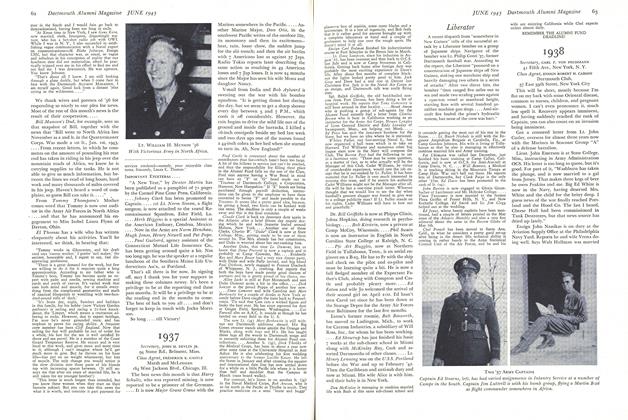
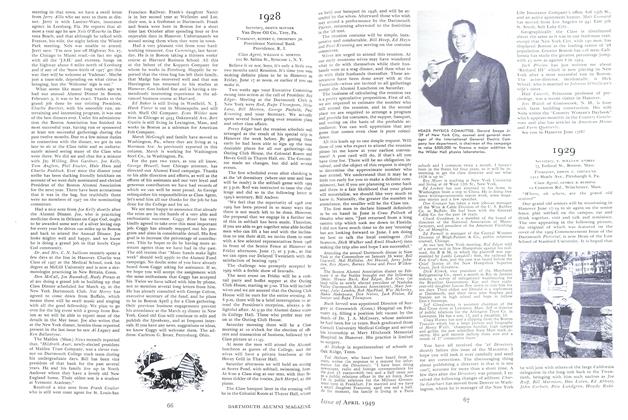
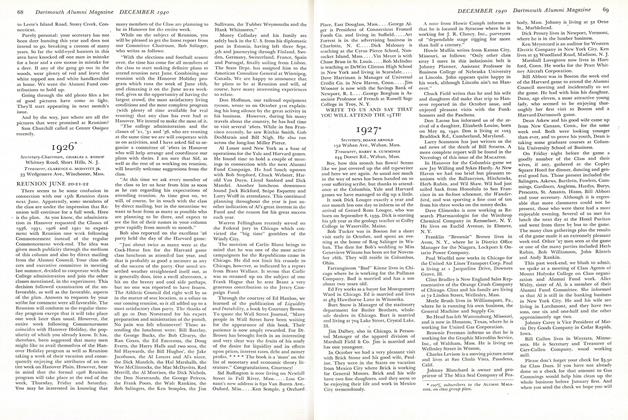
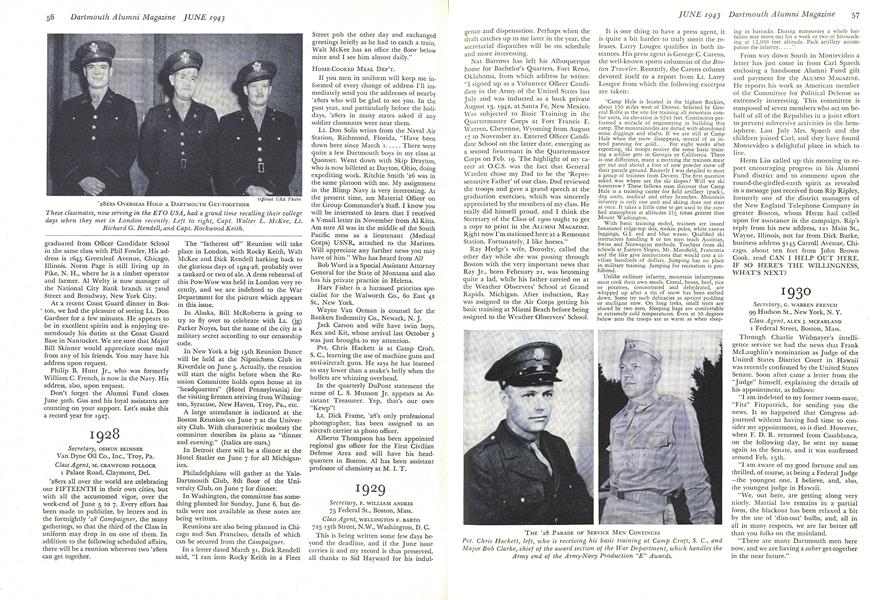
THE '2B PARADE OF SERVICE MEN CONTINUES Pvt. Chris Hackett, left, who is receiving his basic training at Camp Croft, S. C., andMajor Bob Clarke, chief of the award section of the War Department, which handles theArmy end of the Army-Navy Production "E" Awards.
Secretary, 75 Federal St., Boston, Mass. Class Agent, 725 13th Street, N.W., Washington, D. C